Checklist vs. tour: which onboarding pattern fits which job
Guided tours and getting-started checklists both drive activation - they just solve different jobs. Here is how each one works, when to reach for it, and how to combine them.
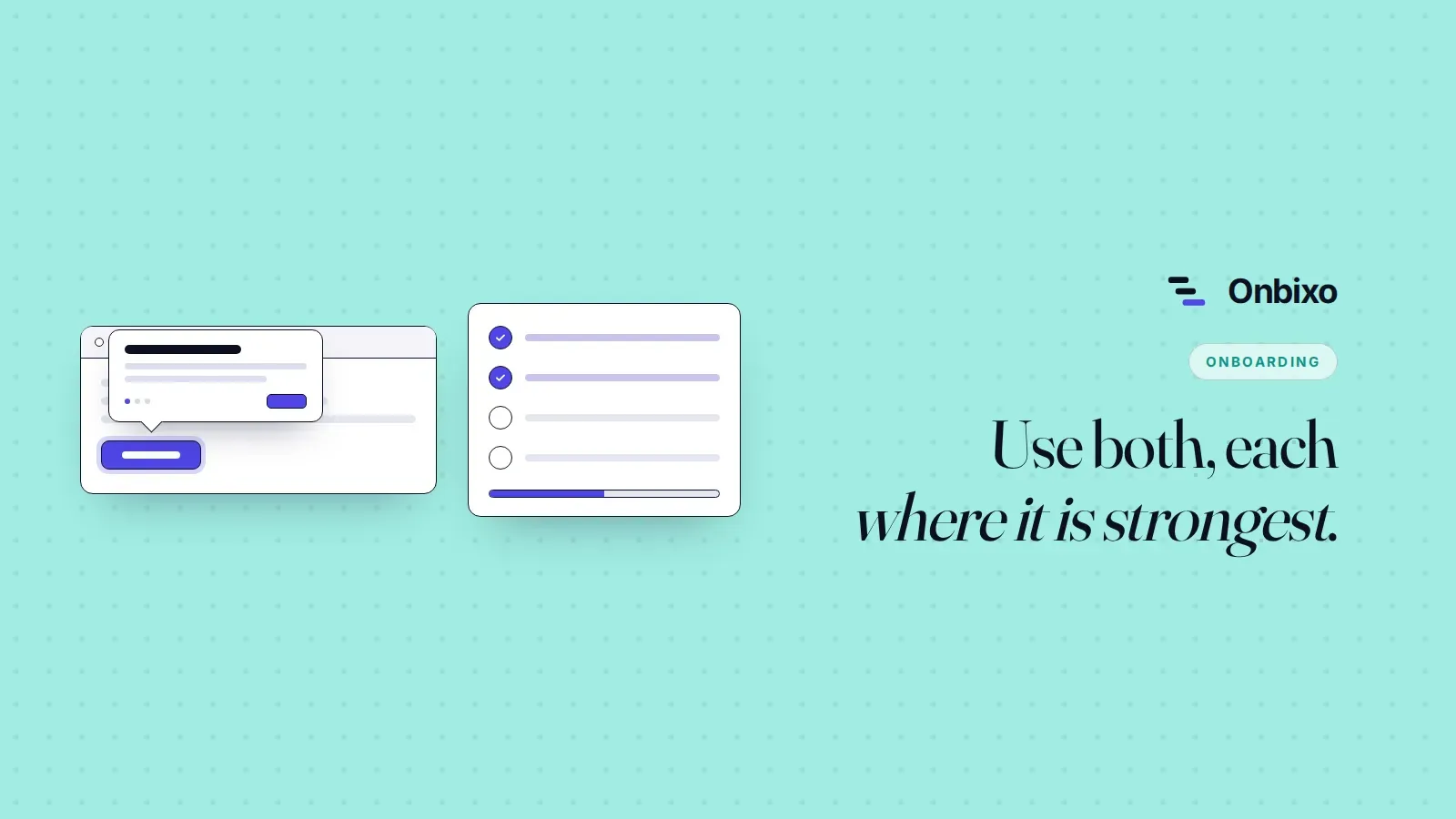
Every new onboarding project starts with the same fork in the road: do you walk the user through the product with a guided tour, or hand them a getting-started checklist and let them work at their own pace? It is tempting to look for a winner, but that is the wrong question. Tours and checklists are different tools for different jobs - the teams with the best activation usually use both, each where it is strongest.
What each pattern is built for
A tour is linear and directed. It takes the wheel for a moment to point at the one thing the user would otherwise miss: "this is the button that creates value, click it." That focus is its superpower - nothing beats a tour for driving a single, specific first action or spotlighting a control a new user cannot find on their own.
A checklist is nonlinear and self-paced. It says: here are the few things worth doing, in whatever order suits you, come back whenever. Its superpower is multi-step setup - the kind of "connect your data, invite a teammate, publish" work that unfolds over more than one session.
A tour directs attention to one moment. A checklist gives structure to many. Reach for whichever matches the shape of the job.
When to reach for a tour
Tours shine when there is a clear path to value and you want the user on it right now:
- One critical first action. If a single step unlocks the product ("create your first project"), a short tour that spotlights it converts beautifully.
- A control people miss. When the key feature is not where users expect, a tour puts a spotlight exactly on it, in context.
- A moment that needs a moment. A brief, guided sequence is the most direct way to say "here is the thing, here is why it matters."
The one rule: keep it short. A focused two-or-three-step tour lands; a fifteen-step walkthrough of the whole UI asks for more attention than a new user has to give. Spotlight what matters, then hand control back.
When to reach for a checklist
Checklists shine when activation is genuinely multi-step and self-paced:
- Setup that spans sessions. Connecting data, inviting teammates, and publishing rarely happen in one sitting - a checklist holds the thread across visits.
- Progress that should persist. A checklist is resumable: a user who finishes two of four items comes back to a launcher that remembers exactly where they were.
- Momentum you want to make visible. Ticking items off is its own small reward, and a visible "2 of 4 done" pulls people back to finish.
Better together
These are not rivals - they compose. A common, high-converting pattern: a short tour the first time a user lands, to nail the single most important action, backed by an always-on checklist in the corner that carries the rest of setup at the user's own pace. The tour creates the first win; the checklist turns it into a finished onboarding.
What a checklist looks like in config
In Onbixo, both are just flows. A checklist is a launcher plus a few items, and the runtime tracks completion per end-user and persists it - so the resumable behavior is free:
{
  "type": "checklist",
  "launcher": { "label": "Get started", "position": "bottom-right" },
  "items": [
    { "title": "Create your first project", "goal": "project_created" },
    { "title": "Invite a teammate",        "goal": "teammate_invited" },
    { "title": "Connect your data",         "goal": "source_connected" },
    { "title": "Publish",                    "goal": "first_publish" }
  ]
}
A tour is the same idea with ordered, element-anchored steps instead of a launcher - captured by pointing at the elements in your app. Each checklist item completes when its goal event fires, so progress reflects what the user actually did.

The rule of thumb
Match the tool to the shape of the job: a short tour for the one action that must happen first, a checklist for multi-step setup that unfolds over time, and often both together. Then measure completion - if any single step is bleeding users, that is the one to fix. The best onboarding is the one people finish.
New posts on activation, pricing, and the product - roughly twice a month. No spam, unsubscribe anytime.
 Onboarding
Tooltip copy: the hover hint and the onboarding step
A hover hint and an onboarding tooltip do different jobs and need different words. How to write each one, how long to make it, and when to rename the control.
Onboarding
Tooltip copy: the hover hint and the onboarding step
A hover hint and an onboarding tooltip do different jobs and need different words. How to write each one, how long to make it, and when to rename the control.
 Onboarding
Empty state copy: what to write when the screen is blank
Three kinds of empty state need three kinds of copy. Here is what the heading, the line under it and the button should say on each of the screens.
Onboarding
Empty state copy: what to write when the screen is blank
Three kinds of empty state need three kinds of copy. Here is what the heading, the line under it and the button should say on each of the screens.
 Onboarding
Support ticket deflection rate: which tickets can actually be deflected?
Support ticket deflection rate cannot be measured exactly. Here is the narrower number to track, which tickets in-app help removes, and which it never will.
Onboarding
Support ticket deflection rate: which tickets can actually be deflected?
Support ticket deflection rate cannot be measured exactly. Here is the narrower number to track, which tickets in-app help removes, and which it never will.